Business
NCC, Industry Leaders Meet on Boosting Broadband Investment

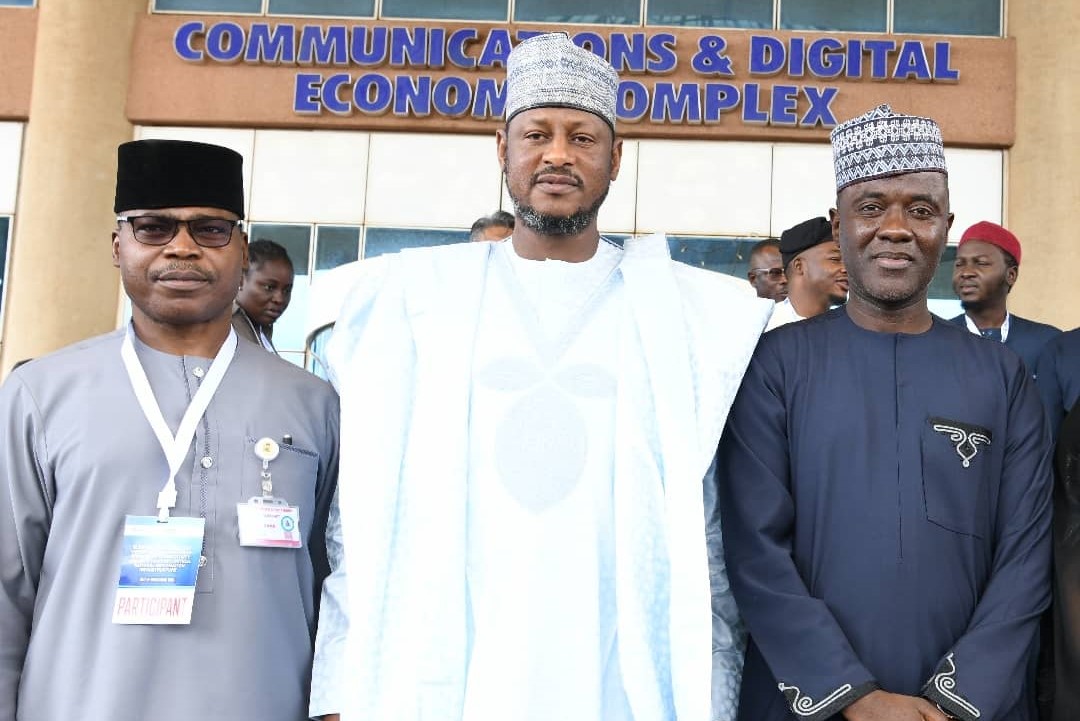
The Nigerian Communications Commission (NCC) used its Business Roundtable, held October 8, 2025, at the NCC Digital Economy Complex in Mbora, to hammer home the critical role of robust broadband connectivity in Nigeria’s economic future.
The event, themed “Right of Way and Protection of Broadband Infrastructure – The Road to Success in Broadband Investment and Connectivity,” gathered top industry executives to strategize on overcoming investment hurdles.
In his opening address, the Executive Vice Chairman (EVC) of the NCC posed a challenging question to the attendees: “How much is an hour of connectivity worth?”
The EVC detailed the catastrophic consequences of digital failure, noting that everything from industrial production to essential security services depends on uninterrupted, real-time data flow. “When connectivity fails, opportunities evaporate, productivity stalls, and lives can be put at risk,” he asserted, highlighting the immediate need to safeguard and expand the nation’s digital backbone. The call was clear: enhanced investment and stringent protection for this essential national infrastructure are non-negotiable for Nigeria’s success.
Drawing comparisons with countries like Rwanda and India, the EVC pointed out that Nigeria has the potential to surpass these nations in digital innovation, especially with its youthful population. “If we equip our youth with reliable, affordable, high-speed connectivity, we can transform our economy from traditional revenue streams to an innovation-driven ecosystem,” he asserted.
The EVC also discussed the ambitious targets set by Nigeria’s National Broadband Plan (2020–2025), which aims for 70% broadband penetration by the end of 2025 and the deployment of 90,000 kilometers of fiber optic infrastructure. Under the leadership of President Bola Ahmed Tinubu and the Minister of Communications, Innovation and Digital Economy, Dr. Bosun Tijani, the NCC is actively pursuing these goals.
To safeguard Nigeria’s telecommunications infrastructure, the EVC highlighted the Critical National Information Infrastructure (CNII) Presidential Order signed in June 2024. This order provides law enforcement with the authority to protect telecom assets from vandalism and theft, ensuring continued service provision. The NCC has established a Telecommunications Industry Working Group to oversee the operationalization of this mandate, focusing on compliance with security standards and public awareness initiatives.
In conclusion, the EVC reiterated the importance of collaboration among stakeholders to enhance broadband connectivity and protect critical infrastructure. “Together, we can pave the way for a more connected, resilient, and prosperous Nigeria,” he concluded, leaving attendees with a sense of urgency and purpose in advancing the nation’s digital landscape.
Read full speech here:
REMARKS BY THE EVC AT THE BUSINESS ROUNDTABLE ON
IMPROVING INVESTMENTS IN BROADBAND CONNECTIVITY AND
SAFEGUARDING CRITICAL NATIONAL INFRASTRUCTURE HELD AT
THE NCC DIGITAL ECONOMY COMPLEX, MBORA, ON OCTOBER 08,
2025
Theme: “Right of Way and Protection of Broadband Infrastructure – The Road
to Success in Broadband Investment and Connectivity”
PROTOCOLS
Permit me to begin with a question that frames our purpose today: How much is an
hour of connectivity worth?
Consider the industrialist in Enugu closing an overseas shipment; the miner in Zamfara
consulting geologists remotely; the entrepreneur in Lagos running an online store; the
technician in Yenagoa checking real-time dashboards; the merchant in Kano
coordinating cross-border payments; and our security services relying on live intelligence
feeds. In each case, connectivity is the quiet enabler. When it fails, opportunities
evaporate, productivity stalls—and in critical situations, lives can be put at risk.
History shows that nations that embraced steam, rail, and electrification surged ahead.
Today, data, broadband, and AI are the new engines. Those who seize the moment
prosper; hesitation carries a heavy cost.
Why Connectivity Matters
When we talk about connectivity, our minds go to faster downloads or smoother video
calls. But the scope and impact extend far beyond these. Connectivity today equals
economic inclusion, productivity, and national resilience.
As of August 2025, Nigeria had achieved a broadband penetration rate of roughly
48.81% with over 140 million people having internet access. The ICT/telecom sector is
already one of the leading contributors to Nigeria’s GDP. Research shows that a 10%
increase in broadband penetration can drive approximately 1.38% GDP growth in
developing economies so imagine what a 20%, 30%, 40% increase in broadband
penetration would do: (there would be more billions in economic output, new jobs, new
services, and innovation hubs across our states.)
2
For individuals and small businesses, broadband access turns local markets into national
and global ones. It transforms opportunities for our graduates from local to global digital
earning possibilities. It transforms a state economy from being dependent on traditional
revenue streams to fostering an innovation-driven ecosystem. Let us look at how this
has impacted countries like Rwanda and India, for example. Rwanda has positioned
itself as an African hub of digital services by investing heavily in backbone fibre and
digital governance. India’s outsourcing and IT services industry is worth hundreds of
billions of dollars (worth over $240 billion annually), enabled largely by early and
consistent investment in digital infrastructure and human capacity.
With over 200 million people and a median age of 18, Nigeria can not only follow those
trajectories but surpass them—if we equip our youth with reliable, affordable, highspeed connectivity.
Progress and Challenges
Under the leadership of President Bola Ahmed Tinubu, and the Honourable Minister
of Communications, Innovation and Digital Economy, Dr. Bosun Tijani, Nigeria is
pursuing the ambitious targets of the National Broadband Plan (2020–2025). This plan
sets a clear path to achieve 70% broadband penetration by the end of 2025 and to deploy
90,000 kilometres of fibre optic backbone infrastructure across the country.
At the Nigerian Communications Commission (NCC), we have translated this vision
into deliberate and strategic action. We are driving broadband expansion, strengthening
regulation, and safeguarding the industry—even in the face of a challenging operating
environment. Let me highlight a few initiatives that we have undertaken:
1. Through the sustained advocacy of the Commission, and efforts of the Office of the
National Security Adviser (ONSA) as well as the Federal Ministry of
Communications, Innovation and Digital Economy (FMCIDE), the Critical
National Information Infrastructure (CNII) Presidential Order was signed by
President Bola Ahmed Tinubu in June 2024. The CNII Presidential Order
guarantees proactive protection of Nigeria’s telecommunications infrastructure by
providing the Executive backing for law enforcement agents to deal with vandalism,
theft and denial of service to these assets, while ensuring continued network service
provision by operators. The Commission, working closely with the Office of the
National Security Adviser has been tasked with ensuring the full operationalisation
of this mandate in the telecommunications sector. To achieve this, we have set up a
Telecommunications Industry Working Group to coordinate its operationalisation.
3
Our first task has been to ensure strict compliance with baseline standards for site
security, maintenance, and access control.
We have also launched a broad public awareness drive, including TV and radio
jingles, social media campaigns, and community engagement initiatives, to mobilise
citizens in protecting telecom infrastructure. In addition, the Commission alongside
ONSA is deepening collaboration with sub-nationals and their institutions, as well
as the judiciary—for deterrence and speedy prosecution. Through mediation,
enforcement, and prosecutions of vandals, the NCC and ONSA are giving practical
effect to the Presidential Order in safeguarding Nigeria’s digital lifelines. Within the
last two years, ONSA has successfully dismantled major cartels responsible for the
theft of telecommunications equipment across the country.
2. One of the most significant barriers to broadband deployment in Nigeria has been
the high cost of Right of Way (RoW) fees charged by state governments, despite a
resolution by the Nigerian Governors Forum fixing the rate at N145 per linear meter.
Recognising this challenge, the Commission intensified advocacy with states to
reduce or waive these fees to accelerate broadband rollout. Within the past two years,
five additional states—Adamawa, Bauchi, Enugu, Benue, and Zamfara—have
waived RoW fees entirely. This brings the total number of states offering zero RoW
charges to eleven (11), while 17 states have capped it at N145 per metre. Our
sustained engagement with state governments, including today’s gathering
underscores our commitment to creating an enabling environment for broadband
expansion.
We are also promoting the “dig-once” coordination with public works to cut
avoidable fibre damage and lower civil-works costs by sharing ducts and plans. Our
goal is uniform, predictable RoW countrywide, paired with clear permitting SLAs.
3. In line with our economic regulatory mandate, earlier this year, the Commission
approved the application of tariff rates that are both cost-reflective and competitive
within the telecommunications industry. This strategic regulatory intervention has
significantly strengthened investor confidence in the Nigerian telecommunications
sector. I can confirm to you that operators have made collective commitment to
investing over $1 billion in additional rollout investments to expand broadband
coverage and capacity nationwide. We will keep monitoring quality, so consumers
see the benefit in better service.
4
4. The NCC has commissioned a wholesale Fibre Study, which is likely to open up
existing backbone, and any built in the future, on comparable, transparent terms so
that backbone owners and Internet Service Providers (ISPs) can interconnect more
easily. This intervention will unlock last-mile expansion and faster backhaul.
5. Transparency & Data: The Commission is expanding performance disclosures—
outage reporting, QoS/QoE maps, and compliance dashboards—to anchor
accountability across the value chain. What gets measured gets managed; what is
published gets improved.
Despite these significant efforts, some challenges remain.
Infrastructure attacks and vandalism continue to pose a challenge. Between January and
August 2025 alone, Nigeria recorded 19,384 fibre cut incidents, 3,241 cases of
equipment theft, and over 19,000 cases of denials of access to telecom sites.
Together, these disruptions have caused prolonged outages, revenue losses, increased
security costs, and delayed service restoration. They demonstrate why infrastructure
protection must be at the centre of our collective agenda.
Another persistent challenge facing broadband expansion in Nigeria is the fragmented
and unpredictable Right of Way (RoW) regimes across different states, which create
delays and cost uncertainties for operators. This problem is compounded by
inconsistent enforcement of critical infrastructure protection, weak coordination with
road authorities, and the absence of clear construction planning protocols. Beyond
these, the sector continues to contend with energy supply volatility, multiple taxation,
and cumbersome permitting processes, all of which pose significant headwinds to
progress.
The Urgency of Now
Governors, ministers, colleagues: time is not on our side. The global digital race is
accelerating. Artificial Intelligence is transforming industries; outsourcing is shifting to
low-cost, high-connectivity environments. If our broadband backbone is weak, our
youth will be marginalized, and our economy will likely not achieve its full potential.
In earlier eras, a community without a railway or electricity could still subsist. In today’s
world, a community without digital connectivity is invisible. It is cut off from education,
markets, access to healthcare, social services, and opportunities.
5
We must act decisively—state by state, community by community—to ensure no one is
left behind.
A Shared Responsibility and Call to Action
Every Governor and State represented in this room holds a strategic lever. Waiving
RoW charges, protecting telecom infrastructure, and proactively supporting fibre
deployment are decisions that can determine the prosperity or stagnation of your states.
In states that have waived RoW and supported infrastructure protection, operators are
expanding networks with greater confidence. This proves that policy direction matters.
But we need alignment across all 36 states and the Federal Capital Territory. If every
state embraces uniform, pro-investment policies, we can transform Nigeria into a
continental digital powerhouse.
In this regard, let me make some concrete requests to you:
1. Be a partner in the operationalisation and enforcement of telecom assets as critical
infrastructure.
2. Adopt 100% RoW waiver statewide (or at minimum the NGF benchmark), with
clear SLA timelines for approvals.
3. Institutionalise coordination between road/public works and operators—shared
planning portals, advance works notifications, and dig-once protocols to prevent
accidental cuts.
4. Embrace transparency: Publish standard processes, timelines, and fees; adopt singlewindow permitting where possible.
5. Create state digital-infra funds/incentives to crowd in private fibre in rural or
underserved areas; leverage PPPs for open-access backbone and metro builds.
6. Facilitate energy resilience: Support hybrid/solar power at sites to improve uptime
and reduce OPEX and emissions.
Why This Roundtable Matters
This is a strategic crossroads. Every decision—protective legislation, RoW waivers,
enabling fibre—shapes the future of millions. With alignment, our states can become
digital growth engines; with delay, we risk watching opportunity pass us by. Today’s
discussion is about removing friction so investment flows faster and value reaches
citizens sooner.
6
Tomorrow, the NCC will launch two strategic tools:
1. The Ease of Doing Business Portal, a one-stop-shop that provides information
and link to our 36 States and FCT.
2. The Nigeria Digital Connectivity Index (NDCI), a framework to measure and
publish annually each State’s digital readiness and competitiveness, creating a
transparent scorecard to drive accountability.
Ladies and Gentlemen, in the 21st century, prosperity now lies in data, connectivity, and
human potential. Pipelines of oil are giving way to pipelines of fibre. Factories are being
redefined by how many tech entrepreneurs we nurture, not how many smokestacks we
build.
The Nigerian Communications Commission will continue to protect and expand
Nigeria’s connectivity. But this is not a task we can embark on alone, it is a shared
mission. Together, with Governors and States, operators, the private sector, security
agencies, and development partners, we can ensure our youth become creators, not
merely consumers of digital value.
The digital revolution does not wait. Let us align, invest, and protect, for the prosperity
of our people and the future of our nation.
I leave you with this question: Will we align—or be left behind?
Thank you.
Dr Aminu Maida
Executive Vice Chairman
Nigerian Communications Commission (NCC)
About Cablenews24:
At CableNews24, we’re your trusted companion in navigating today’s fast-paced world. We are your gateway to a world of instant information, updates, and compelling stories. We are not just an online TV and newspaper website, we offer a dynamic mix of up-to-the-minute news, and insightful articles, CableNews24 delivers everything you need to stay connected. We promise to keep you informed, entertained, and ahead of the curve. From local happenings to global events, we deliver news that matters.
Join the CableNews24 experience – where news meets convenience, and your world comes alive.
CableNews24 – News, Anytime, Anywhere.
For Advertisement, Event Coverage/MC, Public Relations, Story/Article Publication, and other Media Services, kindly send an email to: cablenews24.com@gmail.com OR Kindly call: 08023535955 . To stay updated with the latest news stories, kindly visit cablenews24.com published by AAAANDREL GLOBAL SERVICES



AMVCA 12: A Week-Long Cinematic Extravaganza

Ex‑depot price remains unchanged – Dangote Refinery

Zenith Bank Welcomes New Chairman, Engr. Mustafa Bello

ELC 5.0: NULASS LASU Pushes Cultural Identity, Leadership as Pillars of Governance

UEFA Semi-Finals: Second Legs Set for Dramatic Finish Live on SuperSport

Akume and the Benue Rebirth: When Statesmanship Speaks Louder Than Strife

Refinery Financing: Dangote Group Slams False Claims on ‘Rift’ with Elumelu

2026 Workers’ Day: Globacom Salutes Nigerian Workforce

Dangote Refinery Welcomes Back Redeployed Engineers
